Domain Authority Explained: What SaaS Founders Need to Know
Domain Authority is one of the most misunderstood metrics in SEO. Here's what DA actually measures, what a good score looks like for SaaS, and how to improve yours — backed by data.

Every SaaS founder with a Moz or Ahrefs account has done it: refreshed the dashboard, stared at the Domain Authority number, and wondered why it won't move. DA has become the default shorthand for "how strong is my site?" — and that's a problem. Because most founders misunderstand what DA actually measures, what it doesn't measure, and what they should do about it.
Here's the truth: Domain Authority is not a Google metric. A higher number does not guarantee better rankings. And chasing DA points through cheap links will hurt you more than help. But used correctly, DA is a genuinely useful compass for your SEO strategy. Let's break it down.
What Is Domain Authority?
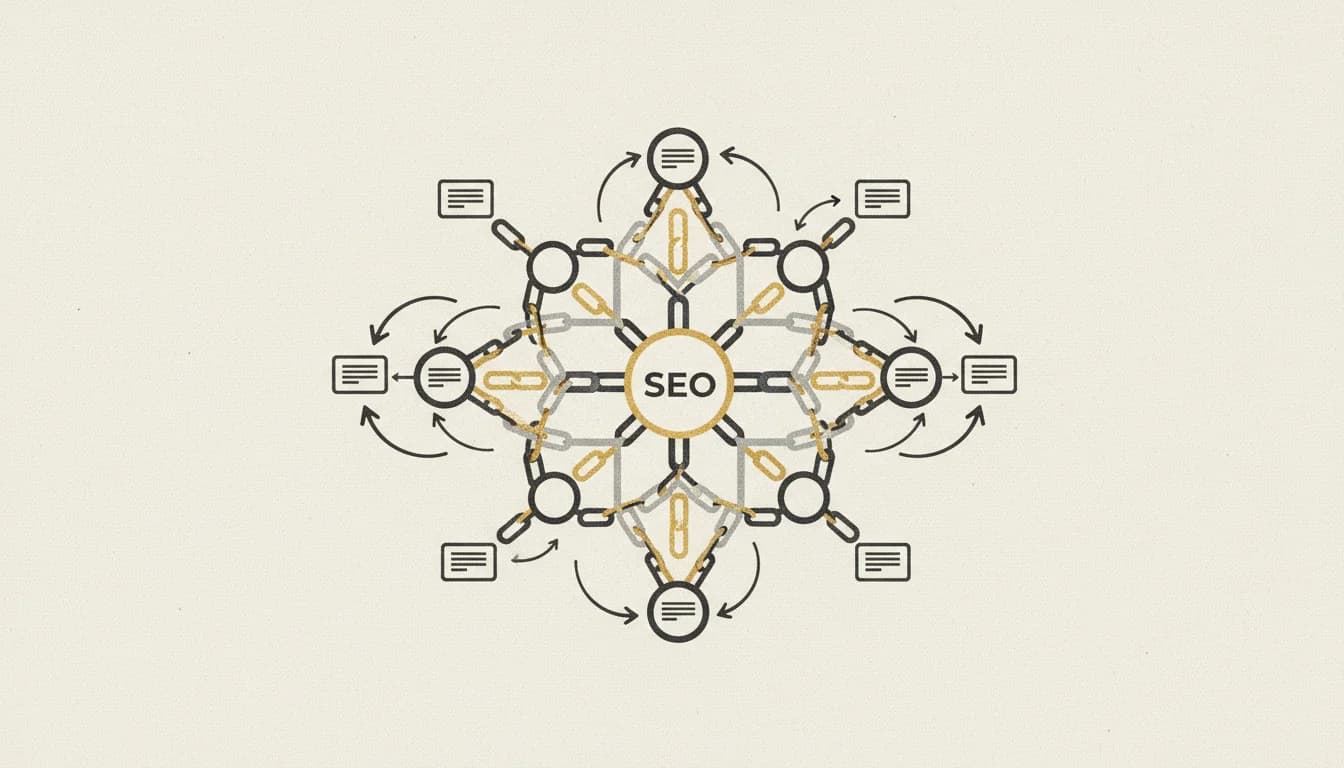
Domain Authority is a search engine ranking score developed by Moz that predicts how likely a website is to rank in search engine result pages. It ranges from 1 to 100, with higher scores indicating greater ranking potential.
Moz upgraded to Domain Authority 2.0 in 2019, replacing their old linear model with a neural network trained on real search results. The current algorithm evaluates over 40 factors, including:
- Linking root domains — the number of unique websites linking to you
- Link quality — the authority and trustworthiness of those linking sites
- MozRank — a measure of link equity flowing to your site
- MozTrust — how close your backlink sources are to known trusted sites
- Spam Score — detection of manipulative or unnatural link patterns
All of this is built on Moz's Link Explorer index: 43.8 trillion links across 743 million domains.
Google's John Mueller has confirmed this repeatedly — in 2019, 2020, and 2022: "We don't use domain authority. We generally try to have our metrics as granular as possible." DA is a third-party predictive metric from Moz, not a signal Google uses for crawling, indexing, or ranking. Treat it as a useful benchmark, not a direct lever.
The Numbers Behind Domain Authority
The data connecting DA to search performance is clear — even if the relationship isn't as simple as "higher DA = higher rank."
The correlation coefficient of 0.30 tells an important story. DA and rankings are related — but the relationship is moderate, not deterministic. Backlinko's study of 11.8 million Google search results found that the #1 result has an average of 3.8 times more backlinks than positions #2 through #10. And 92% of top-10 results have a DA of 35 or higher.
But correlation is not causation. In an Onely study of 2,000 keywords, the site with the highest DA among the top 3 results held the #1 position only 34% of the time. In the other 66% of cases, a lower-DA site outranked the higher-DA site. Content relevance, search intent, and page-level signals often matter more than raw domain authority.
What DA does tell you: where you stand relative to your competition. If your competitors average DA 45 and you're at DA 15, you have ground to cover. If you're at DA 42 and they're at 45, you're in the fight.
DA vs DR vs Authority Score: What's the Difference?
Domain Authority isn't the only authority metric. Ahrefs has Domain Rating (DR), Semrush has Authority Score (AS). They measure related but different things — and confusing them leads to bad decisions.
| Metric | Creator | What It Measures | Update Speed | Best For |
|---|---|---|---|---|
| DA | Moz | 40+ factors (links, spam, trust) | Slower (pattern-based) | Competitive benchmarking |
| DR | Ahrefs | Backlinks only | Every 15 minutes | Link building outreach |
| AS | Semrush | Links + traffic + spam signals | Every 2 weeks | Holistic SEO audits |
The critical difference: DR is based exclusively on backlinks. It ignores content quality, spam signals, traffic, and domain age. This makes it faster to update but also easier to manipulate — one experiment showed a worthless site reaching DR 70 through purchased Fiverr links, while its DA stayed low because Moz's spam detection caught the pattern.
DA correlates with DR about 68% of the time within a 5-point range. But they can diverge significantly for sites with unusual link profiles. Semrush's Authority Score typically runs 15-20% higher than equivalent DA numbers because it factors in organic traffic alongside backlinks.
Don't chase any single metric. Use DA for benchmarking against competitors, DR for evaluating link-building opportunities, and AS for a holistic view. If all three tell a consistent story, you can trust the signal. If they disagree, investigate why.
What's a "Good" Domain Authority for SaaS?
"Good" is relative. A DA of 30 is strong for a SaaS product launched six months ago. That same score is weak for a company with five years of content and funding. Context matters more than the number itself.
| DA Range | What It Means | Timeline to Reach |
|---|---|---|
| 1–19 | Brand new site, no link building | Starting point (85%+ of new sites) |
| 20–39 | Early-stage SaaS with initial content | 6–18 months of consistent work |
| 40–59 | Competitive — can rank in less saturated niches | 18–36 months |
| 60–79 | Strong authority, top 5% globally | 24–48+ months |
| 80–100 | Industry leaders: HubSpot (92), Canva (93), Zapier (91) | Years of sustained investment |
The SaaS/Technology industry averages a DA of 52, with top-10% companies needing DA 70+. But here's what matters more than the absolute number: your DA relative to the sites you're competing against in search results. A niche SaaS tool with DA 35 can absolutely outrank a general-purpose platform with DA 60 — if it has stronger topical authority and better content for the specific queries it targets.
DA uses a logarithmic scale. Moving from DA 10 to 20 might take a few months of steady link building. Moving from DA 70 to 80 could take years. Each additional point requires exponentially more effort than the last — like climbing a mountain where the slope steepens with every step.
Seven Ways to Increase Your Domain Authority
DA growth is slow and deliberate. There are no shortcuts that work. But these seven strategies — backed by data — consistently move the needle. Most of them come down to the same thing: earning links from pages that are topically close to yours, which is why a listing in the right directory category outperforms a scattering of unrelated ones.
DA improvements are not instant. Early movement becomes visible in 60-90 days if you fix technical issues and earn steady backlinks. Meaningful gains — the kind that change your competitive position — usually take multiple quarters. Moving from DA 30 to 50 requires 12-18 months of consistent SEO work. Plan accordingly.
Five DA Myths SaaS Founders Should Stop Believing
DA is useful — but only if you understand what it is and what it isn't. These five myths trip up SaaS founders more than any others.
Domain Authority in the Age of AI Search
Here's the forward-looking reason to care about DA in 2026. AI-powered search engines — ChatGPT, Perplexity, Google's AI Overviews — are reshaping how people discover software. And your domain's authority profile influences whether AI models cite you.
An Ahrefs study of 75,000 brands revealed something surprising: brand mentions across the web correlate 3x more strongly with AI visibility than backlinks do (correlation coefficient 0.664 for brand mentions vs. 0.218 for backlinks). YouTube mentions showed the strongest correlation of all at 0.737.
But backlinks still matter — especially for ChatGPT. An SE Ranking study of 129,000 domains found that sites with 32,000+ referring domains are 3.5 times more likely to be cited by ChatGPT than sites with around 200. High-trust domains (Domain Trust score above 90) earn nearly 4x more AI citations than low-trust sites.
The takeaway: building domain authority through quality backlinks positions you for both traditional Google rankings and AI search citations. It's not either/or. Sites with strong backlink profiles, high trust scores, and broad brand mentions across the web are more likely to be referenced when someone asks ChatGPT "What's the best tool for [your category]?"
For a deeper dive on building the backlink foundation that drives both DA and AI visibility, read our complete guide to backlinks for SaaS.
Start Building Your Domain Authority Today
DA growth is a long game. But the compounding effect means every month of consistent effort builds on the last. Here's your starting checklist.
Domain Authority isn't a perfect metric. It's not a Google ranking factor. And it definitely isn't the only number that matters. But it remains one of the most practical ways to measure your SEO progress, benchmark against competitors, and identify where you need to invest. The SaaS founders who build DA systematically — through quality backlinks, useful content, and sound technical foundations — don't just climb a leaderboard. They build a compounding asset that drives organic traffic for years.
Building DA is part of a broader launch and growth strategy. Start today, stay consistent, and let the compounding do its work.
Every listing on SaaS Cubes includes a permanent do-follow backlink — even on the free plan. Submit your URL, our AI generates the listing, and you start building domain authority in minutes. See pricing and get started →
Sources
- [1]Domain Authority: Is It A Google Ranking Factor? — Search Engine Journal
- [2]We Analyzed 11.8 Million Google Search Results — Backlinko
- [3]Average Domain Authority Needed to Rank in 2026 — LinkScope
- [4]Domain Authority Statistics: 60+ Eye-Opening Stats — SEO Sandwitch
- [5]DA and DR Correlate with Rankings — But Not How You Think — Onely
- [6]Top Brand Visibility Factors in ChatGPT, AI Mode, and AI Overviews (75K Brands) — Ahrefs
- [7]New Data: Top 20 Factors Influencing ChatGPT Citations — Search Engine Journal
- [8]Domain Rating vs Domain Authority: What To Know in 2026 — Loganix
- [9]Why DA, AS, and DR Can Lead to Wrong Decisions — SISTRIX
- [10]How to Increase Domain Authority: 6 Tactics That Work — NoGood
- [11]Moz DA (Domain Authority) Explained — Xamsor
- [12]Canva's SEO Strategies for 270M Monthly Visitors — Mindbees
- [13]How Long Does It Take to Grow Domain Authority? — Neil Patel
- [14]100+ AI SEO Statistics for 2026 — Position Digital
Mateusz Pawlica
With over 12 years of experience building digital products — from mobile apps to AI-powered web platforms — Mateusz specializes in creating modern web applications and implementing AI automation for businesses. He has shipped 20+ projects across SaaS, e-commerce, and education, including Mapa Oświatowa, a map of every school in Poland.