How to Get Your First 100 Users Without an Audience
Product Hunt won't save you and SEO is too slow. How founders actually get their first 100 users in 2026 — with real numbers.
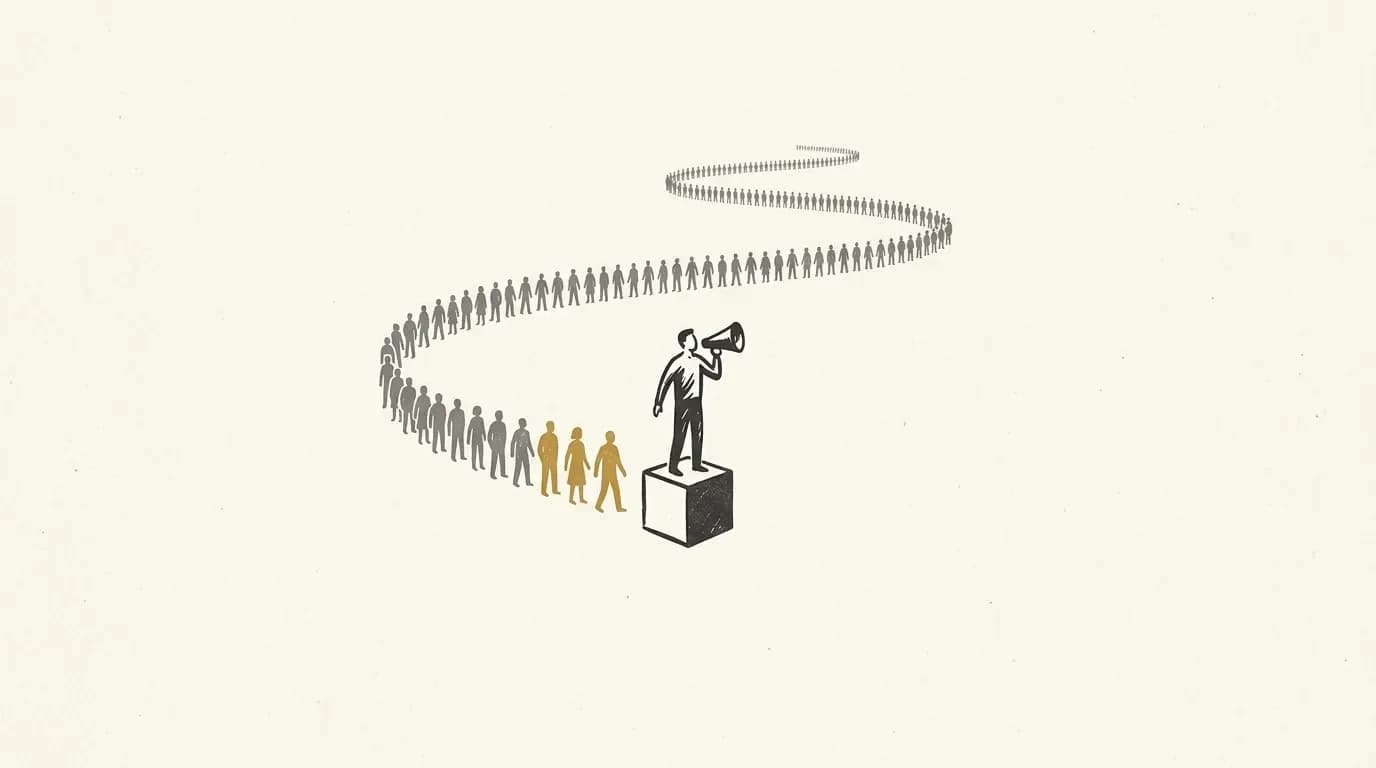
You shipped. The product works, the landing page is live, and the signup counter says three — you, your test account, and your mom. Now what?
If that stings, you're in the largest cohort in software history. AI made building trivial: a quarter of Y Combinator's Winter 2025 batch had codebases that were roughly 95% AI-generated, and 80% of builders on Lovable don't even identify as technical. The result is a supply explosion — the App Store added ~560,000 new apps in the first half of 2026, nearly as many as in all of 2025 — while downloads grew just 2%. Everyone can build now. Almost nobody can distribute.
One founder put it perfectly in an Ask HN thread this spring: "Every distribution channel has a cold start problem. You need traction to get traction." This post is about breaking that loop — with real numbers from founders who did it, not hypotheticals.
Building Was the Easy Part
Here's the uncomfortable math of 2026. App supply doubled; human attention didn't. Venture capital noticed — in Forbes' reporting on the shift, one investor calls distribution "the last sustainable moat," and another prizes a "day zero distribution advantage": founders who know exactly who will buy before they finish building.
We see this every week in the SaaS Cubes review queue: polished, AI-assisted products arrive daily; distribution plans almost never do. The founders aren't lazy — they've simply spent 100% of their learning budget on building. If you're in that group, read the post-ship playbook alongside this one: it covers what breaks before distribution is even your problem.
You don't have a day-zero advantage. You have a working product and zero followers. That's fine — but it means you have to be honest about which channels function at zero, and which ones only pretend to.
The hard part is not building a working product. The hard part is finding people to use it.
Why the 2023 Playbook Stopped Working
Three tactics dominate the advice you'll get. All three have quietly degraded.
Product Hunt amplifies audiences — it doesn't create them
Only around 10% of Product Hunt launches get featured now, down from 60–98% in 2020–2023, and a non-featured launch typically sees 100–500 visitors and 1–15 signups. When five founders published their real May 2026 launch data, first-week signups ranged from 71 to ~450 — and the highest-ranking launch reported 0% paid conversion (a usage-based product, measured early). The roundup's own conclusion: "Product Hunt amplified the audience each founder already had. It did not create one."
One founder who hit Top 50 organically and got zero signups from it diagnosed the problem precisely: "People browsing PH are in discovery mode. They're not in pain right now."
Build-in-public is a networking practice, not a funnel
Indie Hackers documented the retreat in early 2025: the biggest build-in-public accounts — levelsio, Danny Postma, Damon Chen, Jon Yongfook — have gone partly or fully private, citing copycats and burnout. Longtime indie hacker Jason Leow called it outright: "Tweets don't get no reach no more. Building in public or not. The algo is too fickle now." Build-in-public still earns you founder friends and useful feedback. It earns you customers only if your customers are founders.
SEO is a compounding channel, not a first-quarter channel
Ahrefs found that as few as 1.74% of newly published pages — at most ~6% by the study's most generous cut — reach Google's top 10 within a year, and the average #1 result is five years old. Worse, when an AI Overview appears, the top result loses 58% of its clicks. Write content — but write it knowing it pays out in quarters, not weeks.
Here's the honest picture, channel by channel:
| Channel | What it gives you at zero | The catch |
|---|---|---|
| Direct outreach | Your first 10–30 users | Manual, slow, allergic to templates |
| Niche communities | Your first 100 | 2–4 weeks of helping before any pitch |
| Directories | A trickle now, compounding SEO + AI visibility later | Infrastructure, not a faucet |
| Launch platforms | A one-day amplifier | Amplifies an audience you must already have |
| Build in public | Founder friends | Customers only if you sell to founders |
| SEO / content | Almost nothing this quarter | Only ~2–6% of new pages hit top 10 within a year |
| Paid ads | A fast, expensive lesson | 57% of founders who run ads wait 7+ months for ROI — or can't measure it |
The Only Move That Works at Zero: Conversations
Every credible source on this topic converges on the same answer, and it's the least glamorous one available.
Paul Graham wrote it in 2013: recruit users manually, one at a time. Airbnb's founders went door to door in New York. The Collison brothers would say "Right then, give me your laptop" and install Stripe on the spot. Founders resist this, Graham says, out of "a combination of shyness and laziness" — and because they underestimate compounding: 100 users growing 10% a week is 14,000 users in a year.
Lenny Rachitsky's study of how the biggest consumer apps got their first 1,000 users found only seven strategies — and most companies relied on a single primary one. And in MicroConf's ~700-founder State of Independent SaaS survey, half of indie founders lean on communities and referrals (reporting stronger customer lifetime value, especially early on), while 57% of those running paid ads either wait 7+ months for ROI or can't tell whether ads work at all.
Pick one outbound motion and one community. Ignore everything else for 30 days. Here's how that breaks down — call it the Conversations-First Sequence: six steps in strict order, cheapest attention first, launches last.
Step 1: Find Ten People Who Have the Problem Right Now
Not people who might have it. People who are complaining about it, in public, this week.
The founder of Saner.ai tried promoting his AI notetaking app on Reddit and got banned and downvoted. Then he flipped the approach: he searched for posts where people described the exact problem his product solves, and messaged those people — asking about their problem instead of pitching. That brought in his first 100 users and still drives daily referrals.
Senja's co-founder did the same with one message. After a launch month that brought 65 signups and roughly six months of "absolute zero" at $0 MRR, he used Reddit search to find someone displaying screenshots as testimonials on their website and sent a single DM. That person became Senja's first paying subscriber.
One warning about the conversations themselves: don't ask "Would you use this?" Everyone says yes. As one founder confessed on Indie Hackers: "Talked to 20 people for my last product. Every one said they'd pay. Zero did when I launched." Ask "What are you currently doing to solve this?" instead — real buyers already have a workaround, and real validation starts there.
Step 2: Message Them Like a Human
Cold outreach has a terrible reputation because most of it deserves one. Across 7.5 million cold emails in 2025, the average reply rate was 0.45% — roughly one reply per 220 sends. But that average hides the version that works: Apollo's benchmarks put a well-run campaign at 3–5% replies, and campaigns sent to 50 or fewer hand-picked recipients consistently outperform 1,000-recipient blasts. Even better for you: founders and owners reply at 0.57% and companies with 0–10 employees at 0.72% — small-company, founder-to-founder outreach performs about three times better than spraying enterprises.
The existence proof is Tally. Its founders launched with zero audience and cold-messaged 500+ makers and Product Hunt upvoters of competing form tools, asking for feedback rather than pitching. Roughly one in three replied — and many of those repliers became Tally's earliest users and promoters, the seed of a business that went on to pass $100K MRR.
Twenty genuinely personal messages a day beats two hundred templated ones. You're not running a campaign; you're starting twenty conversations.
Step 3: Become a Regular Before You Become a Founder
Communities are where your first hundred users actually live — but they punish visitors who arrive selling.
Reddit's own reddiquette contains the rule everyone cites: if more than about 10% of your activity is submitting your own stuff, you're probably a spammer. Enforcement is pattern-based and unforgiving. One founder documented losing his account permanently — ~70% of posts mentioning the same product, identical content in four subreddits in one day — then losing a second account within two weeks to fingerprinting. Total cost: about five months.
The fastest route to a near-unappealable shadowban is dropping your product link in five subreddits in one day with a fresh account. Spend 2–4 weeks genuinely participating before your product exists in that community at all — and when you do mention it, disclose that it's yours.
Also: pick communities where your customers are, not your peers. A founder who posted daily in r/SaaS, r/startups, and r/Entrepreneur for three months got zero customers — those subreddits are full of other builders. When he switched to finding threads where his actual customers complained about the specific problem, two months of helping produced warm inbound leads and his first paying customers. As one commenter put it: "Distribution isn't a volume problem, it's a relevance problem."
Done right, the ceiling is high. Buildpad's founders gave feedback on other people's projects across indie subreddits and X for months — their early launch posts brought almost nothing, but the accumulated goodwill grew them from a few users past 100 and set up everything that came next. And Excel Formula Bot's founder posted his free tool to r/Excel — the subreddit where his users actually lived — went viral there (and then spread to bigger subreddits), and got his first sale within five minutes of adding a paywall, on the way to $14K+ MRR within eight months.
Step 4: Build Your Discovery Infrastructure Early
Let's be honest about directories, because we run one: submitting to 22 of them will not flood you with users. One founder documented a 23-day sprint across 22 directories plus Quora, Reels, TikTok, and Threads — total result, 8 signups, and every traceable one came from direct human conversation. If a directory promises you a user faucet, close the tab.
So why bother? Because discovery infrastructure compounds while you sleep, and in 2026 it feeds a second reader: AI.
- Backlinks still gate everything in classic search. A listing with a permanent do-follow link is one of the few SEO assets you can acquire in week one, and it keeps working while you do outreach.
- AI assistants cite exactly this kind of page. Ahrefs analyzed 26,283 ChatGPT source URLs and found "best X" lists are the single biggest cited page type — 43.8% of citations across the software, product, and agency prompts studied — and roughly 35% of cited lists come from low-authority domains. Small, fresh, well-structured directory and comparison pages genuinely seed AI answers. Semrush's 100M-citation study found ChatGPT citing Reddit in up to ~60% of responses at its peak (the share swings hard month to month) — the same threads you're already helping in.
- AI-referred visitors convert absurdly well. Ahrefs' own data: visitors from AI assistants were 0.5% of traffic but 12.1% of signups — a 23x higher conversion rate than organic search. Tiny volume, pre-qualified intent.
An afternoon of directory submissions won't replace conversations. It makes sure that when those conversations generate searches — in Google or in ChatGPT — there's something permanent to find.
Step 5: Launch as an Amplifier, Not a Strategy
Now the launch platforms make sense — as step five, not step one.
Buildpad is the clean sequence: months of community participation first, then a Product Hunt launch that ranked #4 with 500+ upvotes and brought nearly 1,000 signups and their first paying customers. The launch didn't create their audience; it amplified the one they'd built. Compare the May 2026 roundup founders who launched without that ramp: strong rankings, 71–450 signups, and paid conversion mostly in the low single digits.
Treat launch day as a milestone in a longer launch system — a spike of awareness, a permanent backlink, some social proof — and it will deliver. Treat it as your acquisition strategy and you'll join the founders writing "I hit Top 50 and got zero signups" posts.
Step 6: Make the First 100 Count
The last trap is celebrating the wrong number. Signups are not users, and users are not customers. The traditional freemium model converts an average of 3.7% of free users to paid. One founder collected 500 signups in 30 days and just three payers — a 0.6% conversion rate. His verdict: "In B2B, a free signup isn't a warm lead. It's an 'I'll try this when I have time' signal." Another got 1,600 signups from a viral Reel and converted 12.
So interrogate your first hundred. The Sean Ellis test is built for exactly this cohort size: ask users "How would you feel if you could no longer use this product?" — 40+ responses gives directional accuracy, and 40% answering "very disappointed" is the product-market-fit benchmark, derived from ~100 startups. Superhuman famously measured 22%, segmented and rebuilt around its most disappointed users, and drove the score to 58% in three quarters. Your first 100 users aren't a vanity milestone; they're the dataset that tells you whether to double down or reposition.
The 30-Day Version
There is no channel that hands a zero-audience founder 100 users. There is only the Conversations-First Sequence: find people mid-problem, talk to them one at a time, earn a place in their community, lay permanent discovery infrastructure, and only then amplify with a launch. Everyone who "skipped" this either had an audience already — or is still at three signups, one of them their mom.
Step 4 takes one afternoon, and this is the part we can help with directly: a SaaS Cubes listing is permanent, hand-curated, and comes with a do-follow backlink — plus your product becomes readable to AI search engines via our llms.txt endpoints. See pricing and submit your SaaS →
Sources
- [1]A quarter of startups in YC's current cohort have codebases that are almost entirely AI-generated — TechCrunch
- [2]Lovable: $500M ARR, 146 staff, 80% non-technical builders — The Next Web
- [3]App Store added nearly as many new apps in H1 2026 as in all of 2025 — 9to5Mac / Sensor Tower
- [4]Ask HN: How did you get your first users with zero audience? — Hacker News
- [5]Distribution Is The New Moat And VCs Are Betting Billions On It — Forbes
- [6]Product Hunt Launch Statistics for 2026 — Shno
- [7]Product Hunt Launch Data: 5 Founders, 8 Questions — HappySupport
- [8]5 days post-launch: Top 50 on Product Hunt, zero signups — Indie Hackers
- [9]Building in public is dead… and it's a good thing — Jason Leow
- [10]Is this the end of 'Build in Public'? Here's why top indie hackers are suddenly disappearing. — Indie Hackers
- [11]How Long Does It Take to Rank in Google? — Ahrefs
- [12]Update: AI Overviews Reduce Clicks by 58% — Ahrefs
- [13]Do Things That Don't Scale — Paul Graham
- [14]How the biggest consumer apps got their first 1,000 users — Lenny's Newsletter
- [15]AI-Driven, Founder-Led: The 2025 State of Micro-SaaS — Freemius / MicroConf
- [16]How I got my first 100 users via Reddit — Indie Hackers
- [17]From $0 to $250 MRR. How we broke out of absolute zero. — Senja
- [18]I help founders get their first 100 users — here's what I've learned — Indie Hackers
- [19]What are B2B Cold Email Response Rates? (2026 Study) — Belkins
- [20]What's a Good Cold Email Reply Rate in 2026? — Apollo
- [21]On starting over, staying sane, and the strategies that brought in 10K users: Marie Martens' story — Indie Hackers
- [22]Our bootstrapped journey towards $100K MRR — Tally
- [23]The complete guide to Reddit self-promotion rules in 2026 — RedShip
- [24]reddit killed my first account and taught me exactly what NOT to do — Indie Hackers
- [25]I posted daily on Reddit for 3 months. Zero customers. Here's what I missed. — Indie Hackers
- [26]How Two Brothers Bootstrapped Buildpad Into a $6K MRR Business — Starter Story
- [27]I Turned My Side Project into A $26K/Month SaaS Tool — Starter Story
- [28]23 days of distributing a SaaS. Here's exactly what happened. — Indie Hackers
- [29]Do Self-Promotional 'Best' Lists Boost ChatGPT Visibility? Study of 26,283 Source URLs — Ahrefs
- [30]The Most-Cited Domains in AI: A 3-Month Study — Semrush
- [31]AI Search Traffic Converts 23x Better (Ahrefs Data) — Ahrefs
- [32]I built a B2B AI tool. Got 500 signups in 30 days, 0 paying customers. — Indie Hackers
- [33]I got 1,600 signups and only 12 paid. Here's what I found. — Indie Hackers
- [34]SaaS Freemium Conversion Rates: 2026 Report — First Page Sage
- [35]How Superhuman Built an Engine to Find Product-Market Fit — First Round Review
Mateusz Pawlica
With over 12 years of experience building digital products — from mobile apps to AI-powered web platforms — Mateusz specializes in creating modern web applications and implementing AI automation for businesses. He has shipped 20+ projects across SaaS, e-commerce, and education, including Mapa Oświatowa, a map of every school in Poland.